How to Choose a Motorbike Tour Operator in Nepal: 12 Checks Before You Book
To choose a motorbike tour operator in Nepal, check four things first: that the company holds a Department of Tourism licence, that its guides are licensed, that its bikes and backup suit your route, and that its quote and payment terms are clear in writing. The 12 checks below cover each in order, with the questions to ask and the red flags that should make you walk away.
| Check | What good looks like |
|---|---|
| 1. Licence | Registered company with a Department of Tourism travel or trekking agency licence |
| 2. Association membership | Member of TAAN or NATTA, which you can check |
| 3. Permits | Arranges restricted-area permits itself, in your name |
| 4. Guides | Licensed riding guide who rides the route regularly |
| 5. Mechanic and backup | Mechanic, spares and a support vehicle on mountain routes |
| 6. Bikes | Named model and year, serviced before your trip, matched to your size and skill |
| 7. Group size | Clear rider-to-guide ratio |
| 8. Itemised quote | Bike, fuel, crew, permits, lodging and meals priced line by line |
| 9. Weather plan | Written policy for road closures and spare days |
| 10. Insurance and rescue | Asks for your policy, explains evacuation honestly |
| 11. Payment | Reasonable deposit, card payment accepted, refund terms in writing |
| 12. Reviews | Recent, detailed reviews from riders, not only trekkers |
In this guide
- Why does the choice of operator matter so much in Nepal?
- 1. Is the operator licensed by Nepal's Department of Tourism?
- 2. Is it a member of a recognised trade association?
- 3. Will it arrange your permits properly?
- 4. Who is the riding guide?
- 5. Is there a mechanic and backup vehicle?
- 6. What bikes does the operator use, and how old are they?
- 7. How big is the group?
- 8. Is the quote itemised?
- 9. What happens if a road closes?
- 10. How does the operator handle insurance and rescue?
- 11. Are the payment terms safe?
- 12. What do recent riders say?
- What are the red flags when booking a motorbike tour in Nepal?
- How does Motorbike Tour Nepal work?
- Questions to ask before you book
- FAQs
Why does the choice of operator matter so much in Nepal?
The choice of operator matters in Nepal because the operator controls your permits, your bike and your safety in places where help is hours away. On a Mustang or Manang ride you may be a full day from a hospital, on roads that change after every storm. A good operator plans for that; a poor one hopes it will not happen.
Nepal’s rules also put the operator at the centre. Restricted areas such as Upper Mustang can only be entered with a permit arranged by a registered agency, and under the rules issued in March 2026 that agency is fully responsible for emergency rescue and logistics (Kathmandu Post, citing the Department of Immigration). That makes the first check the most important.
1. Is the operator licensed by Nepal’s Department of Tourism?
A legitimate tour operator in Nepal is a registered company that holds a licence from the Department of Tourism. Travel and trekking businesses are regulated under the Tourism Act 1978 and its rules, and a company must be registered with the Office of the Company Registrar before it can apply for a tourism licence (Niti Partners; Law Bhandari). Ask for the company’s registration and licence numbers. A real operator will send them without fuss.
Be wary of a “company” that is one person with a website and a WhatsApp number. Freelancers can be good riders, but they cannot legally arrange restricted-area permits, and you have no company to hold to account if things go wrong. Membership of a trade body is a useful second check.
2. Is it a member of a recognised trade association?
A good sign is membership of the Trekking Agencies’ Association of Nepal (TAAN) or the Nepal Association of Tour and Travel Agents (NATTA). Since April 2023, trekkers in Nepal’s national parks and conservation areas must use a licensed guide from a registered agency, and TAAN-registered agencies are the route the rules expect (In Your Pocket; The Longest Way Home). Membership does not guarantee a good ride, but it means the company exists, pays its dues and can be complained about.
3. Will it arrange your permits properly?
A good operator arranges every permit for your route itself, in your name, before you arrive. For Upper Mustang that means the restricted-area permit (US$50 a day inside the restricted area under the rate approved in November 2025) and the Annapurna Conservation Area permit (NPR 3,000). Since 22 March 2026 solo foreign travellers can also get a restricted-area permit, as long as a registered agency arranges it with a licensed guide (Kathmandu Post).
Ask: “Which permits does my route need, and are they in the price?” If the answer is vague, or the operator suggests you can “sort it at the checkpoint”, that is a red flag. Our Upper Mustang permit guide lists exactly what you need. Permits get you through the checkpoints; the guide gets you through the ride.
4. Who is the riding guide?
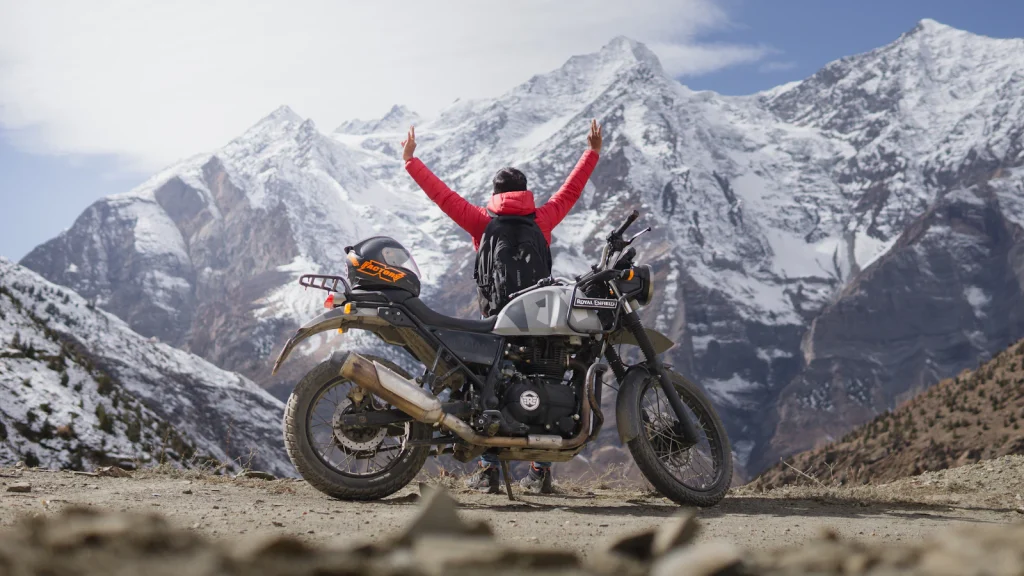
Your riding guide should be licensed, experienced on your exact route and able to ride the same roads you will. Ask how many times the guide has ridden the route this season, which bike they ride, and whether they speak your language well enough to brief you on a blind bend. For Upper Mustang a licensed guide is required by the permit; on other routes it is still the single biggest safety factor.
Good guides set the pace to the slowest rider, ride ahead to warn of buses on narrow ledges and know where the last fuel is. Ask to speak to the guide before you book. Behind the guide you need a mechanic.
5. Is there a mechanic and backup vehicle?
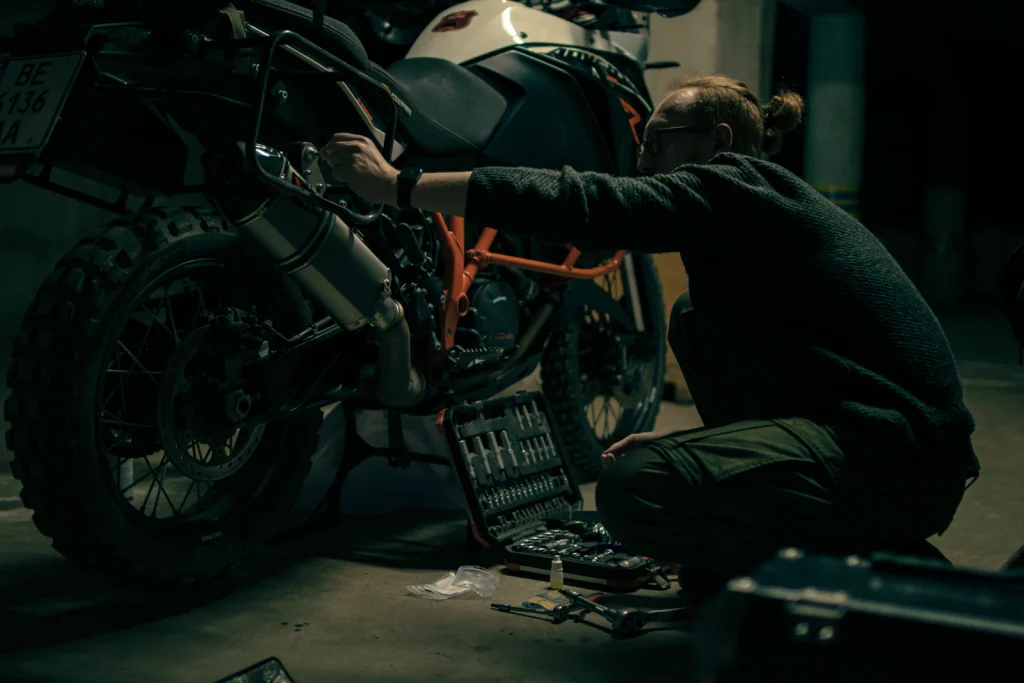
On mountain routes in Nepal, a good operator sends a mechanic and a support vehicle with spares, luggage and a spare bike. A puncture or a broken clutch cable in the Kali Gandaki gorge can end a trip without one. Ask whether the mechanic travels with the group or “can be sent”, what spares are carried, and whether a spare bike comes on routes such as Upper Mustang and Manang.
Shorter, lower routes such as the Kathmandu to Pokhara ride may not need a full support vehicle, so a lighter setup can be fine there. The bikes themselves are the next check.
6. What bikes does the operator use, and how old are they?
A good operator names the exact bike model and year, services it before your trip and matches it to your height, experience and route. Common tour bikes in Nepal include the Royal Enfield Himalayan 450 and 411, the Classic 350, the Honda CRF250L and the Hero Xpulse 200. Ask for photos of the actual bikes, tyre type and age, and whether crash bars and luggage racks are fitted.
Shorter riders should ask about seat height before booking; a light bike such as the CRF250L can make loose ground far less tiring. Our planning guide compares the common models. How many people share that support is the next question.
7. How big is the group?
The right group size depends on the route, but you should always know the ratio of riders to guides. Nepal’s rule for restricted-area trekking allows one licensed guide for up to seven trekkers (under the March 2026 rules), and that is a sensible ceiling for a riding group on hard roads too. Private tours, which many operators offer for one to a few riders, cost more per person but let you set the pace.
8. Is the quote itemised?
A trustworthy quote for a Nepal motorbike tour lists each cost separately: bike, fuel, guide, mechanic and support vehicle, permits, lodging and meals. A guided tour typically costs about US$170–270 per rider per day all in, depending on route and group size (see our tour prices page). A price far below that usually means something is missing: older bikes, no mechanic, cheaper lodges or permits left out.
Ask what is not included, too: international flights, the Nepal visa (USD 30 for 15 days or USD 50 for 30 days on arrival), insurance, riding gear, drinks and tips. Cost is only fair if the plan holds up when the weather turns.
9. What happens if a road closes?
A good operator has a written plan for road closures, because they happen on every major Nepal route. In late September 2026, floods blocked the Beni–Jomsom road at more than 50 places and kept it shut until 9 October (see our 2026 route update). Ask:
- Does the itinerary include a spare day on mountain routes?
- If a road closes, who decides the new route, and does it cost extra?
- If the trip has to end early, what is refunded?
An operator that promises “no problems, roads always open” is either new or not telling you the truth. Weather also links to the next check: what happens if you get hurt.
10. How does the operator handle insurance and rescue?
A good operator asks to see your travel insurance before departure and explains, honestly, when a helicopter evacuation is and is not needed. Your policy must cover riding a motorcycle of the engine size you will hire, at the altitude you will reach (up to about 4,100 m in Upper Mustang), with emergency evacuation included. Many standard policies exclude motorcycling.
Honesty about rescue matters because Nepal has a long-running fake rescue problem. In 2026 Nepal Police charged 32 people, including people at trekking agencies, helicopter firms and hospitals, over staged evacuations used to claim insurance payouts, in a case linked to about US$19.69 million (The Standard; Kathmandu Post). Investigators allege tourists were falsely warned of life-threatening altitude sickness to justify flights (OnlineKhabar). An operator that talks up evacuation, pushes you to upgrade insurance through them, or seems keen on helicopters is a red flag. Payment is the second-to-last check.
11. Are the payment terms safe?
Safe payment terms for a Nepal motorbike tour mean a reasonable deposit, a balance due shortly before you ride, card payment accepted and cancellation terms in writing. Avoid operators that want the full price months ahead by bank transfer to a personal account.
UK riders have an extra safeguard. Under Section 75 of the Consumer Credit Act 1974, a UK credit card issuer can be jointly liable for a purchase between £100 and £30,000 if the supplier breaches the contract, and the House of Lords confirmed in 2007 that this applies to overseas purchases too (Office of Fair Trading). Paying at least part of a deposit by UK credit card can therefore give you a route to a refund if an operator fails to deliver. Check the details with your card issuer, as conditions apply, and expect a card surcharge from many Nepali companies. The last check is what other riders say.
12. What do recent riders say?
The most useful reviews of a Nepal motorbike tour operator are recent, detailed and written by riders rather than trekkers. Look for specifics: the bike model, the guide’s name, how the crew handled a breakdown or a closed road. A page of five-star reviews with no detail, or reviews that only mention treks, tells you little about a riding operation. Ask the operator for a recent rider you can contact; good companies have riders happy to talk.
What are the red flags when booking a motorbike tour in Nepal?
The red flags when booking a motorbike tour in Nepal are signs that an operator is unlicensed, cutting corners or hiding costs. Walk away if you see any of these:
- No company registration or Department of Tourism licence number, or reluctance to share them
- Upper Mustang offered without a licensed guide, or permits “arranged at the checkpoint”
- A price far below US$170 a day for a guided mountain tour, with no breakdown
- No mechanic or support vehicle on Mustang or Manang
- Pressure to pay in full early, or only by bank transfer to a personal account
- Eagerness to arrange helicopter evacuations or sell you insurance
- Promises that roads are always open, or that you can skip acclimatisation
If something goes wrong while you are in Nepal, Nepal’s Tourist Police run a free 24-hour hotline on 1144 (Department of Tourism).
How does Motorbike Tour Nepal work?
Motorbike Tour Nepal is not a tour operator. We help you plan the ride: the route, the season, the bike and a realistic budget. When you are ready to book, we put you in touch with a government-registered Nepali operator that passes the checks above, and you book and pay that operator directly. Read more on our About page.
Want a plan you can check against this list?
Send your dates, route and riding experience. We will come back with a day-by-day itinerary and an itemised cost estimate you can check line by line.
Questions to ask before you book
- What are your company registration and Department of Tourism licence numbers?
- Are you a member of TAAN or NATTA?
- Which permits does my route need, and are they included?
- Who will be my guide, and how often have they ridden this route this year?
- Does a mechanic and support vehicle come with us? Is there a spare bike?
- Which bike will I ride, what year is it, and when was it last serviced?
- How many riders per guide?
- Can you itemise the quote, and what is not included?
- What happens, and what does it cost, if a road closes?
- What deposit do you need, how can I pay, and what are the cancellation terms?
- Can I speak to a rider who did this route recently?
Frequently asked questions
How do I check if a Nepal tour company is legitimate?
To check if a Nepal tour company is legitimate, ask for its company registration and Department of Tourism licence numbers, and check whether it is a member of TAAN or NATTA. A legitimate company shares these quickly and can arrange restricted-area permits in your name.
Do I need a guide for a motorbike tour in Nepal?
You need a licensed guide arranged through a registered agency to ride in restricted areas such as Upper Mustang. On other routes a guide is not always a legal requirement for riders, but it is strongly recommended on mountain roads.
Is it safe to book a Nepal motorbike tour online?
Booking a Nepal motorbike tour online is safe if the operator is licensed, gives you an itemised quote and written terms, and accepts card payment. Paying part of the deposit by credit card can add protection for UK riders.
How much deposit should a Nepal tour operator ask for?
Deposits vary by operator, so compare them and get the terms in writing. Be cautious of any operator that asks for the full price months in advance, or only accepts bank transfers to a personal account.
What should a Nepal motorbike tour price include?
A guided Nepal motorbike tour price should include the bike, fuel, a licensed guide, a mechanic, permits, lodging and most meals. Flights, the visa, insurance, riding gear, drinks and tips are usually extra.
What is the fake helicopter rescue scam in Nepal?
The fake helicopter rescue scam in Nepal involves staged or unnecessary evacuations used to claim insurance payouts. In 2026 Nepal Police charged 32 people in the case. Choose an operator that explains rescue honestly and does not push evacuations or insurance sales.
Can I complain about a tour operator in Nepal?
Yes. In Nepal you can contact the Tourist Police on the free hotline 1144, and raise a complaint with the trade association the operator belongs to.
Ready to plan your Nepal ride?
Send your dates and riding experience and we will help you plan the route, bike and budget, then point you to a registered operator to run it.
Sources
- Kathmandu Post: restricted-area permit rules, March 2026
- Niti Partners: trekking agency registration and the Tourism Act 1978
- Law Bhandari: travel agency licensing in Nepal
- In Your Pocket: Nepal’s mandatory guide rule
- The Longest Way Home: April 2023 guide rule and TAAN-licensed companies
- Kathmandu Post: Nepal charges 32 in fake rescue scam
- The Standard: US$19.69 million rescue scam
- OnlineKhabar: how the fake rescues worked
- Office of Fair Trading: House of Lords ruling on Section 75 and overseas purchases
- Department of Tourism: Tourist Police hotline 1144
- Motorbike Tour Nepal: tour prices
- Motorbike Tour Nepal: Upper Mustang permit guide
- Motorbike Tour Nepal: routes after the 2026 floods
Last checked 16 November 2026.