
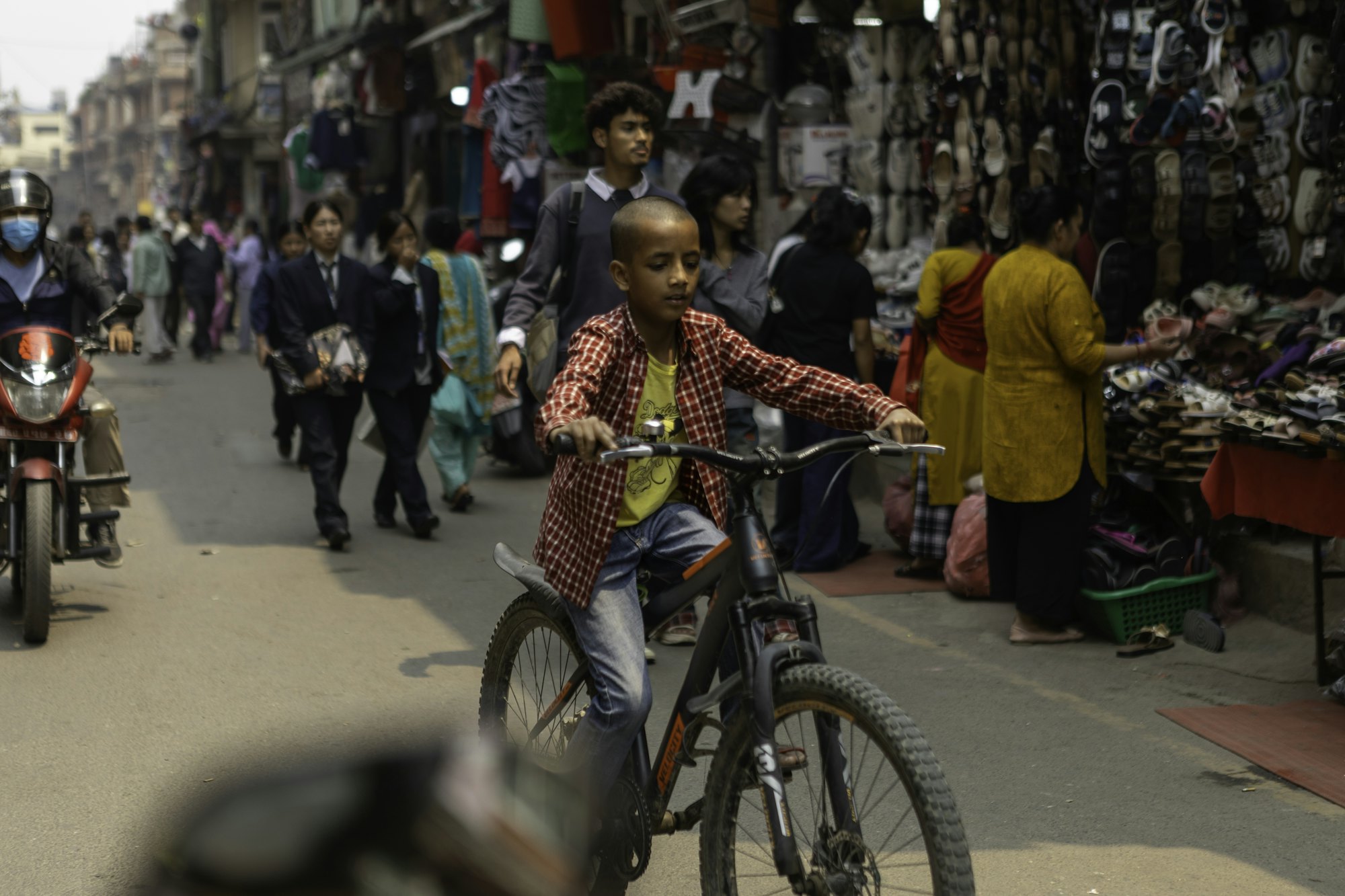
Riding a Motorbike in Nepal as a Foreigner: Licence, IDP and Road Rules
Can you ride a motorbike in Nepal as a tourist? Yes — thousands of foreigners do every year, from scooters around Pokhara’s lakeside to Royal Enfields in Upper Mustang. But the paperwork, the traffic and the mountain roads work very differently from home, and the rules on licences are less clear-cut than most rental shops will tell you.
This guide explains, with official sources, which licence and International Driving Permit (IDP) you need, how to get one in the UK, US and Australia, how to convert to a Nepali licence for longer stays, the rules of the road, police checkpoints and drink-driving, insurance (the bit most riders get wrong), fuel, renting a bike, riding an Indian-registered bike into Nepal and what to do if something goes wrong.
Important: this is practical guidance, not legal advice. Rules and enforcement change. Check with your licensing authority, your insurer, your government’s travel advice and your operator before you travel.
| Quick answers | |
|---|---|
| Can tourists ride in Nepal? | Yes, with a valid home licence covering motorcycles plus an International Driving Permit, or a Nepali licence |
| Which side of the road? | Left |
| Minimum age to drive | 18 |
| Helmet | Compulsory for the rider; wear one as a passenger too |
| Drink-riding | Effectively zero tolerance; frequent breath tests |
| Third-party insurance | Compulsory for every vehicle in Nepal |
| Petrol price | About NPR 200 per litre (October 2026) |
| Emergency number | Police 100 |
In this guide
- Do you need an International Driving Permit in Nepal?
- How to get an IDP in the UK, US and Australia
- Converting to a Nepali licence
- Indian riders: licences and Indian-registered bikes
- The rules of the road in Nepal
- Police and permit checkpoints
- Insurance: the part most riders get wrong
- How safe is riding in Nepal?
- Fuel and breakdowns
- Renting a motorbike as a foreigner
- What to do if you have an accident
- Self-ride or guided?
- Riding in Kathmandu traffic
- FAQs
Do you need an International Driving Permit in Nepal?
To ride legally in Nepal as a visitor you need your full home driving licence with a motorcycle category plus an International Driving Permit — or a Nepali licence. The Australian Embassy in Kathmandu, for example, states that you need a valid Nepali licence or a valid IDP, and that the minimum driving age is 18. An IDP is not a licence on its own; it is a translation of your licence and is only valid when carried with it.
Which IDP: 1949 or 1968?
This is where it gets confusing. IDPs are issued under two international conventions: the 1949 Geneva Convention and the 1968 Vienna Convention. Nepal is not formally a party to either. In practice, the UK government’s travel advice for Nepal states that UK drivers need a 1968 IDP. Other sources still refer to the 1949 permit.
Our advice: get the IDP your own government recommends for Nepal, make sure it covers motorcycles (category A), and carry it with your home licence and passport at all times. If your country issues both types, carrying both costs little and removes any argument at a checkpoint.
How long can you ride on an IDP?
There is no clearly published limit for tourists. An IDP itself is normally valid for one year from issue (three years for some 1968 permits). For long stays or residence, convert to a Nepali licence (see below).
How to get an IDP in the UK, US and Australia
| Country | Where to get it | Notes |
|---|---|---|
| United Kingdom | In person at PayPoint stores (since April 2024; Post Offices no longer issue them) | About £5.50. Bring your photocard licence; must be obtained before you leave the UK |
| United States | AAA or AATA — the only two organisations authorised by the State Department | Valid one year. Beware of websites selling fake “international licences” |
| Australia | Your state or territory motoring club (NRMA, RACV, RACQ, RAA, RAC and others), on behalf of the Australian Automobile Association | About A$49 plus postage; valid 12 months |
Apply at least a few weeks before you travel. Make sure the motorcycle category is stamped on the permit — an IDP for cars only will not help you on a Royal Enfield.
Converting to a Nepali licence
If you are staying long-term, Nepal’s Department of Transport Management (DoTM) can issue a Nepali licence to holders of a valid foreign licence without a driving test, under clause 52 of the Vehicle and Transport Management Act. The process generally involves:
- A recommendation letter from your embassy in Kathmandu.
- Certified copies of your passport, visa and foreign licence.
- An application at a DoTM office (the main office is in Minbhawan, Kathmandu), with a medical check and fee.
- Collection of a smart-card licence.
It takes time and paperwork; for a tourist trip of a few weeks, the IDP route is far simpler.
Indian riders: licences and Indian-registered bikes
Indian riders make up a large share of the motorbikes on Nepal’s roads. An Indian driving licence is widely accepted in practice for short visits, but this is not set out clearly in Nepali law; Royal Enfield’s own Mustang ride documentation asks for a licence valid in India and Nepal and suggests an IDP “in case of doubt”.
Riding an Indian-registered motorbike into Nepal requires a bhansar (customs) permit from the border customs office, charged per day, with a maximum number of days per year. Carry it at all times and extend it at a customs office before it expires. Check the current fees and limits with the Indian Embassy in Kathmandu or the border customs office before you travel.
Let us handle the paperwork
Guided tours include permits, checkpoints and a mechanic; self-guided rides include a 24/7 support line.
The rules of the road in Nepal
- Drive on the left. As in the UK and Australia.
- Helmets: compulsory for the rider. The UK government notes that the law requires only the driver to wear one, but rental shops will provide a pillion helmet and you should always use it.
- Speed limits: 50 km/h in Kathmandu; limits elsewhere are rarely signposted. On mountain roads you will rarely exceed 30–40 km/h anyway.
- Drink-riding: Nepal Police run frequent breath tests, especially in Kathmandu in the evenings, and in practice tolerate no alcohol at all. Fines have risen and are set to rise further. Do not ride after a single drink.
- Documents: carry your licence, IDP, passport (or a copy plus the original nearby), the bike’s registration book (the “bluebook”) or rental agreement, insurance papers and any permits.
- Lights and horn: use the horn before blind bends in the hills — it is expected. Use headlights in tunnels, rain and dust.
- Lane discipline: minimal. Larger vehicles assume right of way; overtaking on blind corners is common.
- Fines: traffic fines have typically been NPR 500–1,000 for common offences; in 2026 police proposed much higher fines to parliament.
Police and permit checkpoints
You will meet police checkpoints on every highway out of Kathmandu and Pokhara and on mountain roads, plus ACAP and immigration checkpoints in the Annapurna region and Mustang — at Beni, Ghasa, Jomsom and Kagbeni, for example. Stop, remove your helmet and sunglasses, greet the officer (“Namaste”), and show your documents. Checks are usually quick and friendly.
In the Annapurna Conservation Area you need an ACAP permit (NPR 3,000 for foreigners). North of Kagbeni, in Upper Mustang, foreigners need a Restricted Area Permit and a licensed guide — you cannot self-ride there. See our Upper Mustang permit guide.
Insurance: the part most riders get wrong
Every vehicle in Nepal must have third-party insurance, which is tied to the bike’s registration; reputable rental shops will have it. It covers damage and injury to others — not you, and not the bike.
Your own travel insurance is what pays for medical care and evacuation if you are hurt, and many standard policies quietly exclude motorcycling. Common restrictions include:
- Cover only for bikes up to 125cc (a Royal Enfield Himalayan is 411–452cc).
- Cover only if you hold a full motorcycle licence at home that is also valid in Nepal.
- No cover for off-road riding or for “touring” as the main purpose of the trip.
- No personal liability cover while riding.
- Mandatory helmet use.
- Altitude limits for trekking and activities (check your policy covers 4,000 m+ for Upper Mustang).
Read the policy wording, not the summary. Look for explicit cover for riding a motorcycle of your engine size as the rider, at your maximum altitude, with helicopter and mountain rescue. If in doubt, phone the insurer and get the answer in writing.
How safe is riding in Nepal?
Nepal records around seven road deaths a day. The main dangers are buses and trucks overtaking on blind bends, overloaded vehicles, unlit vehicles and animals at night, monsoon landslides and rockfall, and riders overestimating their skill on loose surfaces. The UK government lists overloading, negligence, speeding and poor roads among the main causes.
- Never ride after dark in the hills.
- Ride defensively and assume oncoming traffic will be on your side of the road on every bend.
- Wear proper gear: full-face or adventure helmet, armoured jacket and trousers, gloves and boots.
- Avoid mountain roads after heavy rain.
- Build experience gradually: ride the Kathmandu–Pokhara highway or a day ride before the Kali Gandaki gorge.
- Consider a guide for your first trip — they handle traffic, checkpoints and language.
Fuel and breakdowns
Petrol is sold by the state-owned Nepal Oil Corporation through roadside stations; from 1 October 2026 the Kathmandu price was about NPR 200 per litre, slightly higher in remote areas. Fuel is plentiful on main highways but scarcer in the mountains — fill up in Beni and Jomsom on the way to Mustang, and in Besisahar on the way to Manang. Small shops in villages sometimes sell petrol in bottles at a premium.
Royal Enfields are easy to repair: mechanics in most towns know them well. Carry a spare tube, a basic tool kit, a puncture repair kit and your rental shop’s phone number. Support vehicles and mechanics on guided tours remove most of the worry.
Renting a motorbike as a foreigner
Rental shops in Kathmandu’s Thamel and Pokhara’s Lakeside will ask for your licence, a copy of your passport and a cash deposit. Some will not ask for an IDP — that does not make it legal or insured. Never leave your actual passport as a deposit: you need it at checkpoints and hotels.
- Inspect the bike carefully: tyres, brakes, chain, lights and horn.
- Photograph or film every scratch with the owner present.
- Check the bluebook and third-party insurance are valid and in the bike.
- Agree in writing what happens if the bike breaks down far from the shop.
- Ask about pillion helmets, luggage racks and phone mounts.
Prices and recommendations: renting in Kathmandu, renting in Pokhara and motorbike rental in Nepal.
What to do if you have an accident
- Make the scene safe and check for injuries. Call 100 for the police; for medical emergencies call your insurer’s assistance line, which can arrange evacuation.
- Call your rental shop or tour operator immediately.
- Stay calm. Crowds can gather quickly after an accident involving a foreigner, and there may be pressure to pay compensation on the spot. Let a Nepali-speaking guide, your operator or the police handle discussions.
- Photograph the scene, vehicles and any damage.
- Get a police report if anyone is injured or there is significant damage — you will need it for insurance.
- Contact your embassy if you are seriously injured or detained.
Self-ride or guided?
Riding Nepal independently is entirely possible on most routes, and for experienced riders it is a wonderful adventure. But a guide removes most of the problems in this article — licences and checkpoints, translation, accident handling, route-finding and mechanical support — and is mandatory for Upper Mustang. Compare our self-guided tours, which include a 24/7 support line, with our fully guided tours, or read the Nepal motorbike tour planning guide.
Riding in Kathmandu traffic
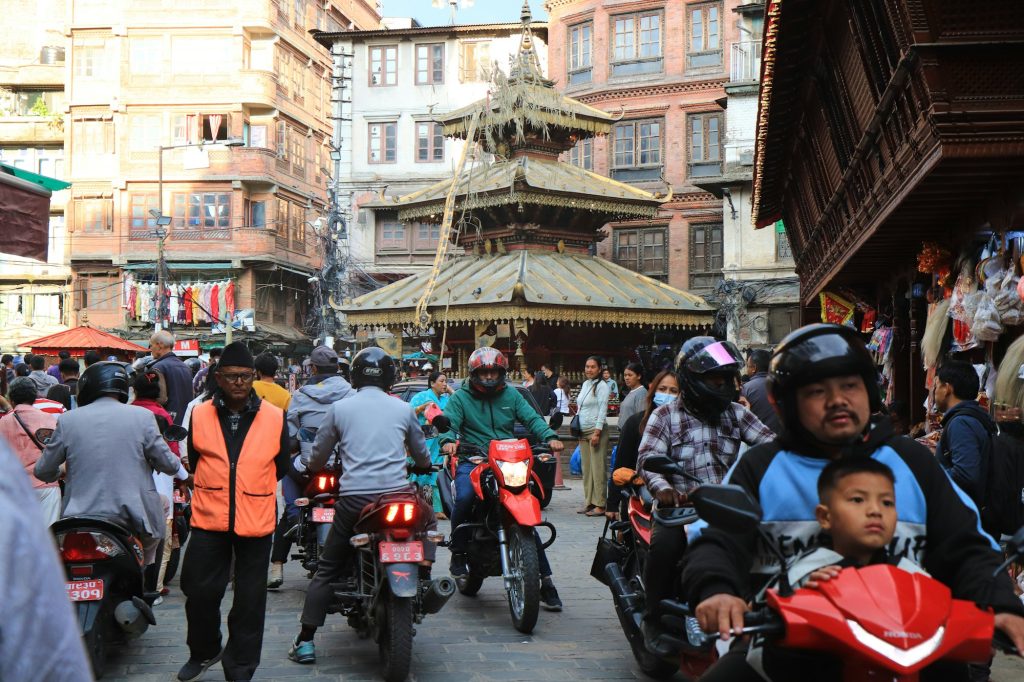
Kathmandu is the hardest place to ride in Nepal: dense traffic, few lane markings, dust and constant horn use. If you are new to riding here, start early on a Saturday morning, when the roads are quietest, or let a guide lead you out of the city.
Frequently asked questions
Can tourists drive or ride in Nepal?
Yes, with a valid home licence that covers the vehicle class plus an International Driving Permit, or with a Nepali licence. The minimum age is 18.
Is an International Driving Permit required in Nepal?
Yes, for foreign licence holders. The UK government advises UK drivers to carry a 1968 IDP. Carry it with your home licence.
Is an Indian driving licence valid in Nepal?
It is widely accepted in practice for short visits, but this is not clearly codified; carrying an IDP is the safe option.
Do I need an IDP to rent a scooter in Nepal?
Legally you should carry one with your licence. Shops may not ask, but police and insurers can.
Which side of the road does Nepal drive on?
The left.
Is wearing a helmet compulsory in Nepal?
Yes for the rider. Passengers should always wear one too.
What is the drink-driving limit in Nepal?
In practice there is zero tolerance, with frequent breath tests. Do not drink and ride.
Can I convert my licence to a Nepali licence?
Yes. The Department of Transport Management can issue a Nepali licence to foreign licence holders without a test, with an embassy recommendation letter.
Can I ride my Indian motorbike into Nepal?
Yes, with a bhansar (customs) permit from the border, charged per day.
Will my travel insurance cover me on a motorbike in Nepal?
Only if it explicitly covers motorcycling at your engine size and altitude. Many policies limit cover to 125cc. Check the wording.
Ride Nepal without the paperwork headaches
Our guided tours handle permits, checkpoints and support so you can concentrate on the riding.