Kathmandu to Lumbini by Motorbike: Routes, Road Status and the Birthplace of the Buddha
Kathmandu to Lumbini is a ride of roughly 260–290 km from the capital down to the plains of the Terai, where the Buddha was born, and it is one of the few long Nepal rides that stays low and almost entirely on tarmac. This guide covers the two main routes (the fast highway via Narayangadh and Butwal, and the scenic way via Pokhara and Tansen), current road status, what to do once you arrive, entry fees, the best months and how many days to allow.
Motorbike Tour Nepal was set up by Govind Rai, who is from Nepal, to help riders plan trips like this one. Lumbini is a stop on our Nepal Highlights Motorbike Tour, and if you want a different shape of trip we put you in touch with a government-registered Nepali operator who can plan it.
In this guide
- Lumbini at a glance
- What is Lumbini and why ride there?
- How far is Lumbini from Kathmandu?
- Which route should you ride to Lumbini?
- Is the road to Lumbini open now?
- Pokhara to Lumbini via Tansen
- Getting around Lumbini on a bike
- Lumbini entry fees and rules
- Best time to ride to Lumbini
- How many days do you need?
- Frequently asked questions
Lumbini at a glance
| Fact | Detail |
|---|---|
| Where | Rupandehi District, Lumbini Province, on the Terai plains close to the Indian border |
| Why it matters | Birthplace of Siddhartha Gautama, the Buddha; a UNESCO World Heritage Site |
| Distance from Kathmandu | About 256–288 km by road, depending on the source and route; tourist buses take around 11 hours |
| Fastest route | Prithvi Highway to Mugling, south to Narayangadh, then the East-West Highway (113 km) to Butwal and on via Bhairahawa |
| Scenic route | Pokhara, then the Siddhartha Highway south through Tansen to Butwal |
| Nearest airport | Gautam Buddha International Airport, Bhairahawa; about 30 minutes’ flight from Kathmandu |
| Road status (Nov 2026) | Open, with a daily 11:00–16:00 closure at Ghoptebhir on the Prithvi Highway from 21 November, until further notice |
| Entry fee | Conservation fee for foreign visitors listed at Rs 700–1,000 per day by the Lumbini Development Trust (see fees) |
| Best months | October to November and February to March |
| Riding level | Easy to moderate: paved highways, heavy traffic, one notorious hill section at Daunne |
What is Lumbini and why ride there?
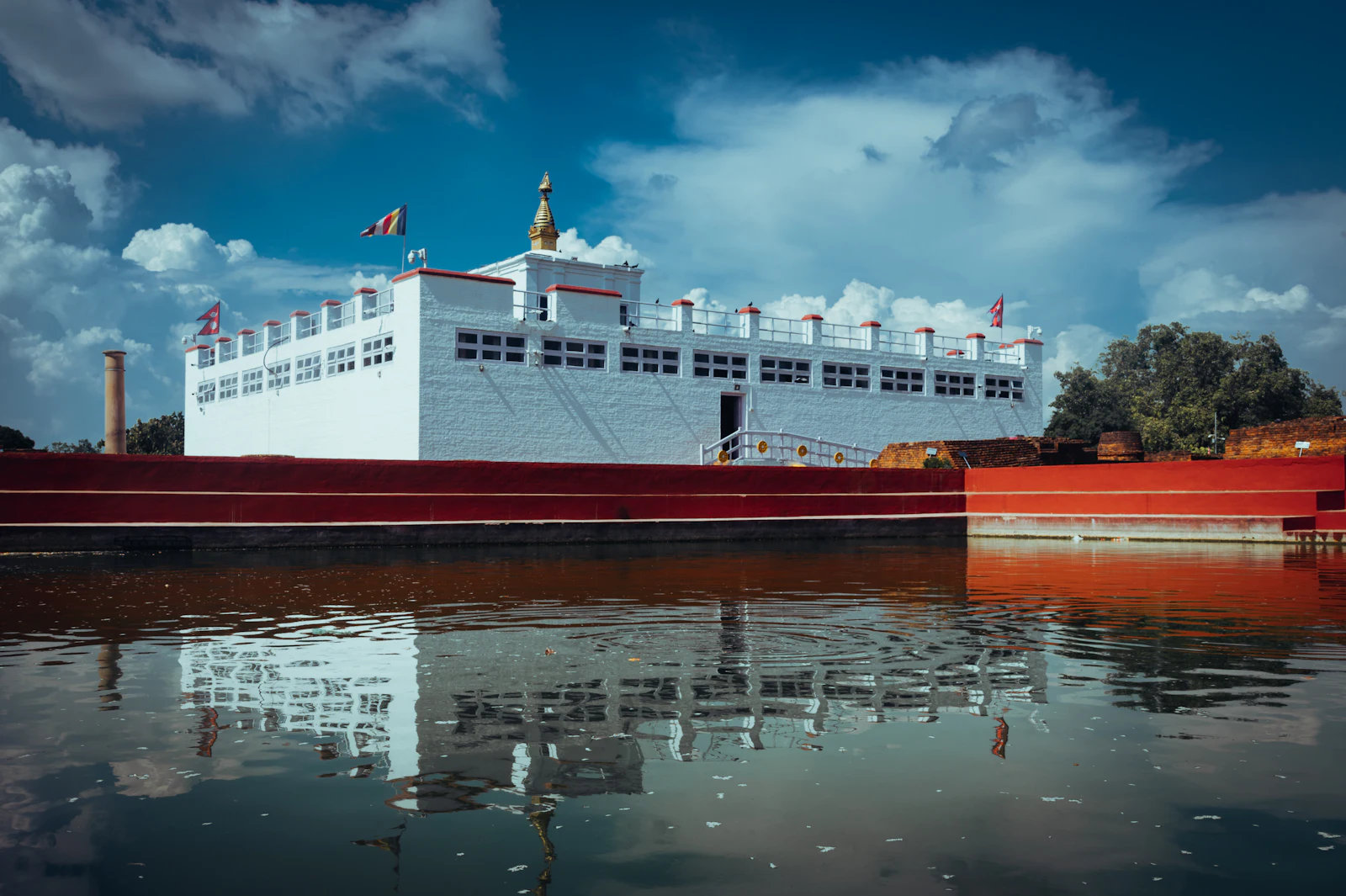
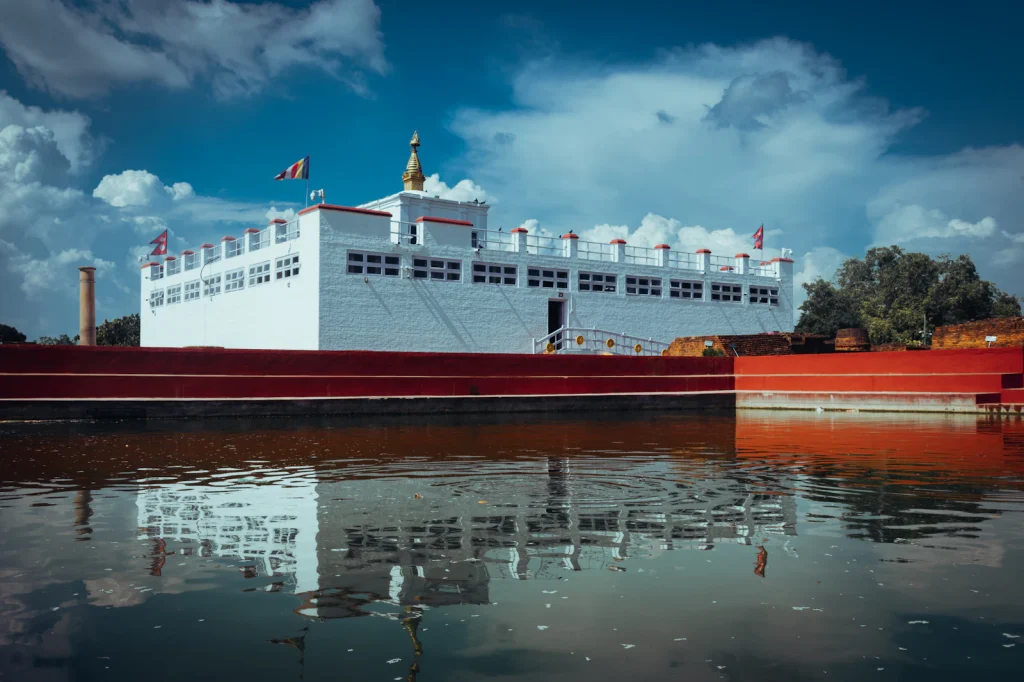
Lumbini is the place where Siddhartha Gautama, who became the Buddha, was born, and it is one of the most important pilgrimage sites in the world. UNESCO dates his birth to 623 BC and points to the sandstone pillar put up by the Mauryan emperor Ashoka in 249 BC, whose inscription records his visit to the birthplace. The Maya Devi Temple stands over brick remains dating from the 3rd century BC to the present day.
Around the temple, the Japanese architect Kenzo Tange drew up a master plan between 1972 and 1978. It lays the site out along a north–south axis about three miles (5 km) long in three parts: New Lumbini Village in the north, the Monastic Zone in the middle, where countries from across Asia and beyond have built temples and monasteries along a long central canal, and the Sacred Garden in the south with the Maya Devi Temple, the Ashoka pillar and the Puskarini pool.
For a rider, Lumbini earns its place for a different reason as well. It sits at the bottom of a loop that takes in the hill towns of Bandipur and Tansen, Pokhara and the Chitwan plains, so you see Nepal change from Himalayan foothills to flat, hot rice country in a few days. It is a good contrast to the mountain routes, and one of the best rides in Nepal in winter. How you get there is the next decision.
How far is Lumbini from Kathmandu?
Lumbini is about 256–288 km from Kathmandu by road. Booking site Bookaway gives 256 km and the Travelling Mandala guide (updated May 2026) gives 288 km, and the difference is mostly where you start and end in each city. Tourist buses take around 11 hours and cost Rs 1,300–1,500, which is a fair guide to how slow the traffic is.
| Leg | Distance | Notes |
|---|---|---|
| Kathmandu to Mugling (Prithvi Highway) | The slowest leg of the trip | One-lane sections since the 2026 floods; daily closure at Ghoptebhir |
| Mugling to Pokhara (for the scenic route) | About 90 km, around 2 hours | Widening nearly complete (Republica) |
| Narayangadh to Butwal (East-West Highway) | 113 km | Being widened to four lanes; three-lane climb at Daunne |
| Pokhara to Butwal (Siddhartha Highway) | Most of the 181 km highway, which runs Pokhara–Butwal–Belahiya | Twisting hill road through Syangja, Waling and Tansen |
| Bhairahawa (Siddharthanagar) to Lumbini | About 26 km | Flat, about 30 minutes by local bus |
By air, Kathmandu to Bhairahawa takes about 30 minutes, and Bhairahawa’s airport became Gautam Buddha International Airport in May 2022. That matters if a non-riding partner wants to fly down and meet you. For riders, the real choice is between the two roads in the next section.
Which route should you ride to Lumbini?
Ride via Narayangadh and Butwal if you want to reach Lumbini quickly; ride via Pokhara and Tansen if you have time and want the better scenery. Most riders end up doing both: one on the way down and the other on the way back, or a full loop through Chitwan.
| Via Narayangadh and Butwal | Via Pokhara and Tansen | |
|---|---|---|
| Roads | Prithvi Highway, then East-West (Mahendra) Highway | Prithvi Highway, Pokhara, then Siddhartha Highway |
| Character | Trishuli valley, then flat plains and the Daunne hill | Hill country, hairpins, the old town of Tansen |
| Time from Kathmandu | One long day, better split in two | Three to four days with stops |
| Traffic | Heavy trucks and buses all the way | Busy, with rockfall on the Butwal–Palpa section |
| Good for | Getting there; combining with Chitwan | Riders who want the ride to be the point |
The fast way: Mugling, Narayangadh and Butwal
The fast way leaves Kathmandu over Nagdhunga and follows the Prithvi Highway down the Trishuli valley to Mugling, then turns south along the river to Narayangadh. The new 2.68 km Nagdhunga tunnel opened in July 2026 and saves 20 to 30 minutes, but it opened in phases, so check with your operator whether motorbikes can use it on your dates.
From Narayangadh you cross the Narayani and ride 113 km west on the East-West Highway to Butwal. The road has been under widening since 2019: 70 km will be four-lane, 29 km four-lane with service lanes, and the 14 km climb over the Daunne hill will be three lanes (Rising Nepal). Daunne is the stretch to respect. It was blocked 63 times between mid-July 2024 and mid-July 2025, and as recently as March 2026 rain and mud closed it for days. By July 2026 the eastern section was reported at 92% complete. From Butwal, follow the road south to Bhairahawa and west to Lumbini.
The scenic way: Bandipur, Pokhara and Tansen
The scenic way follows our Kathmandu to Pokhara ride first, with a night in Bandipur, then drops south from Pokhara on the Siddhartha Highway. That road is covered in its own section below. Before choosing either, check what the roads are doing this week.
Want Lumbini without planning every leg?
The Nepal Highlights tour rides Kathmandu, Bandipur, Pokhara, Tansen, Lumbini and Chitwan in 11 days. Tell us your dates and riding experience and we will send a day-by-day plan and an itemised cost estimate.
Is the road to Lumbini open now?
Yes: as of 21 November 2026 both routes to Lumbini are open, but the Prithvi Highway out of Kathmandu has a planned daily closure. From 21 November, the Malekhu–Mugling section at Ghoptebhir in Chitwan is closed to all vehicles from 11:00 to 16:00 every day, until further notice, while crews remove loose rock and soil (Chitwan District Administration Office, via The Rising Nepal). Traffic is held at Ramailo Danda from the Kathmandu side and at Jugedi and Aaptari from Narayangadh.
- Ghoptebhir: landslides closed the highway twice on 9–10 November 2026, the second time overnight until 07:45 (Kathmandu Post). Ride through before 11:00 or after 16:00, and leave Kathmandu early.
- Narayani bridge: the Narayanghat–Butwal road was closed at night on 21 and 22 November (23:00–04:00) for blacktopping on the Gaindakot side, after which about 60 km of continuous new pavement runs to Daunne (Republica). Another reason not to ride at night.
- Krishnabhir: the August 2026 flood that cut the Prithvi Highway for 18 days left a temporary track and one-lane sections between Nagdhunga and Mugling. Our 2026 floods route update has the background.
- Daunne: fine in dry weather, but the first place to close in heavy rain.
Road notices in Nepal change week to week, so check that day’s news or ask your operator the night before. Our guide to whether it is safe to ride a motorcycle in Nepal covers traffic habits on these highways. The scenic route has its own issues, covered next.
Pokhara to Lumbini via Tansen
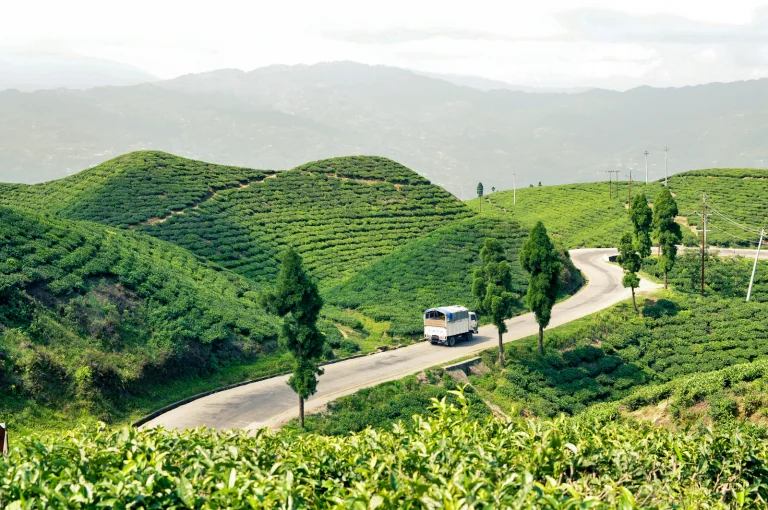
Pokhara to Lumbini via Tansen is the better ride: the Siddhartha Highway runs south from Pokhara through Syangja, Putalibazar and Waling to Tansen, then down to Butwal, crossing hill country the whole way. It is also slower. The section between Butwal and Palpa (Tansen) is known for rocky terrain and frequent rockfall, and many buses avoid the highway because of its narrow curves.
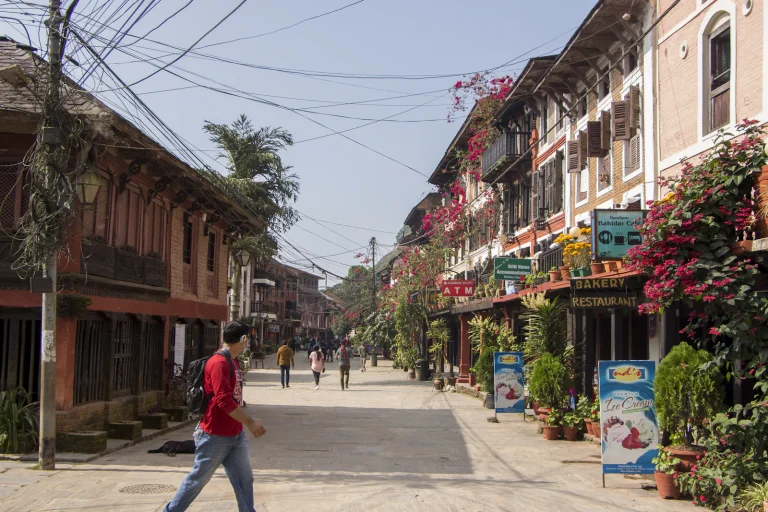
Our Highlights itinerary splits it into two easy days: about 120 km from Pokhara to Tansen, a night in the old Newari trading town at about 1,370 m, then about 90 km down to Lumbini, arriving in time for an afternoon at the temple. Tansen is worth the night for its lanes, its views and its cooler evenings before the plains.
Work is under way on the worst part of the descent. The 1.13 km Siddhababa tunnel near Butwal was 65% complete in December 2025, its contract requires completion by April 2027, and the government’s May 2026 budget said it would be finished this fiscal year. Until then, expect roadworks and occasional holds above Butwal. Once you reach Lumbini, the bike mostly stays parked.
Getting around Lumbini on a bike
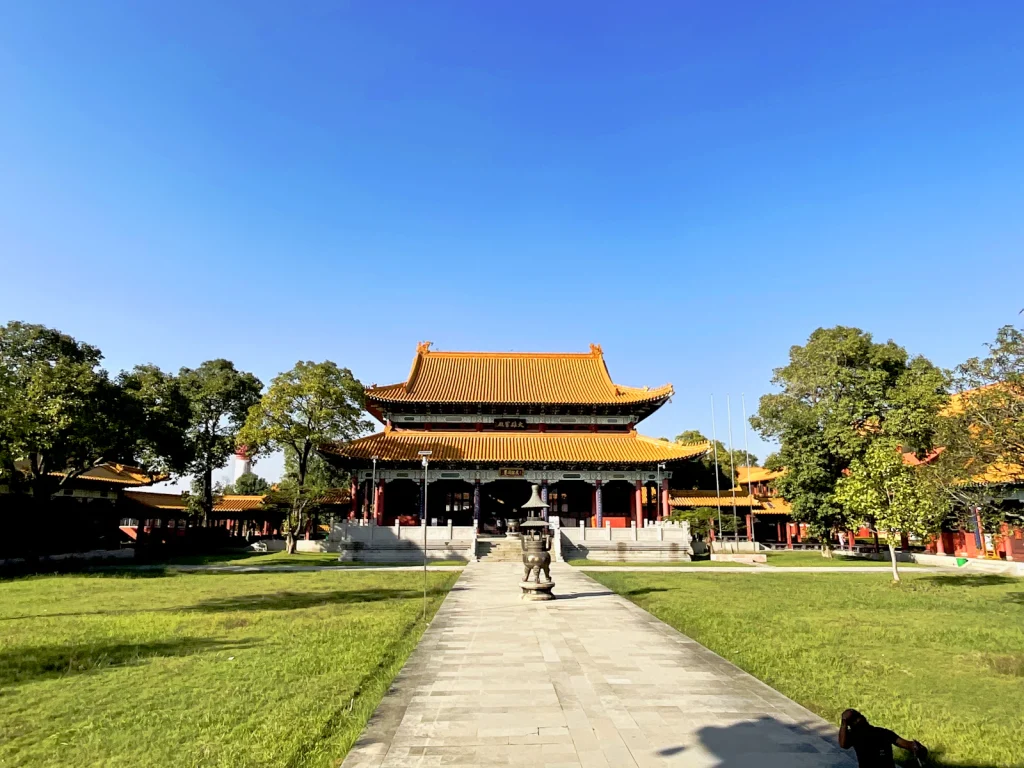
Inside Lumbini, plan to park the motorbike and explore on foot or by bicycle. The development area is about 5 km from end to end, and the Monastic Zone is laid out along a central canal and pedestrian walkway. Bicycles can be hired near the main gate for a small daily fee. We found no current official rule on private motorbikes inside the development area, so follow the gate staff.
Do not count on the electric shuttle. Five electric buses and 14 electric vans were bought for Lumbini in 2020, but in April 2026 the Kathmandu Post reported they were still largely idle, with the buses run for less than 48 hours before being handed to the airport.
- Sacred Garden: the Maya Devi Temple, the Ashoka pillar and the Puskarini pool, where tradition says Maya Devi bathed before the birth.
- Monastic Zone: monasteries built by countries and Buddhist communities from across Asia and beyond, west and east of the canal.
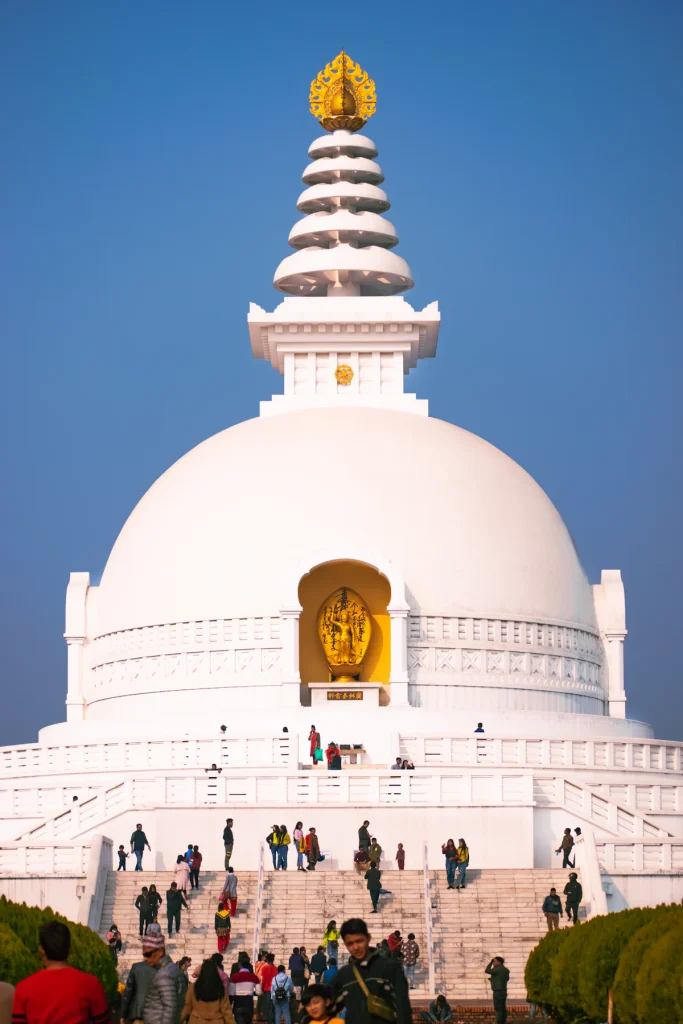
- World Peace Pagoda: the large white stupa at the northern end.
- Opening times: temples are generally open from early morning until about noon and again until about 5pm (In Your Pocket, April 2026).
One full afternoon and the following morning covers the main sights comfortably. Before you go in, you need a ticket.
Lumbini entry fees and rules
Lumbini charges a daily conservation fee, and for foreign visitors from outside South Asia the Lumbini Development Trust lists it at Rs 700 on one version of its entry page and Rs 1,000 on another, both updated on 20 November 2026. Fees rose in May 2026, by up to 75% for third-country visitors (Kantipur), so budget Rs 1,000 and check at the gate.
| Item | Listed charge (Lumbini Development Trust) |
|---|---|
| Conservation fee, foreign nationals | Rs 700 or Rs 1,000 per day (the Trust’s two pages differ) |
| Conservation fee, Indian nationals | Rs 80 per day |
| Still camera | USD 3 per day (foreigners) |
| Video camera | USD 25 per day (foreigners) |
| Drones | Need permission from the District Administration Office, the Civil Aviation Authority of Nepal and the Trust |
| Exempt | Monks, nuns, persons with disabilities and residents of the three surrounding districts |
Pay in cash, by QR code or online at the Trust’s ticket site. Take your shoes off before entering the temple, dress modestly with shoulders and knees covered, and leave food and drink outside. Photography is allowed in open areas but restricted in the inner sanctum. The weather decides when this is all pleasant, which is the next question.
Best time to ride to Lumbini
The best time to ride to Lumbini is October to November and February to March, when the plains are dry, clear and warm rather than hot. The two seasons to avoid are high summer and the depths of winter, for opposite reasons.
| Season | What to expect at Lumbini |
|---|---|
| Oct–Nov | Dry, clear and warm; the best riding of the year |
| Dec–Jan | Pleasant afternoons, but dense morning fog on the Terai: runway visibility at Terai airports is often near zero on winter mornings (Nepali Times). Ride after the fog lifts |
| Feb–Mar | Warming up and dry; good, though rain closed Daunne for days in March 2026 |
| Apr–Jun | Very hot: Bhairahawa passed 40°C in April 2026 and reached 41.5°C in June 2026 |
| Jun–Sep | Monsoon; landslides on the Prithvi Highway and at Daunne |
Our best time for a motorbike tour in Nepal guide covers every month and route. Season sorted, the last question is time.
How many days do you need?
Allow at least four days for a Kathmandu–Lumbini–Kathmandu ride on the fast highway, and ten to eleven for the full loop through Pokhara, Tansen and Chitwan. The plains are flat but the traffic is slow, and nobody should ride the Prithvi Highway or Daunne in the dark.
| Trip | Suggested days | Shape |
|---|---|---|
| Lumbini return, fast way | 4 | Down via Narayangadh and Butwal, a full day at Lumbini, back the same way |
| Lumbini and Chitwan | 5–6 | Add a night at Chitwan on the way back; the Highlights tour allows about 170 km for Lumbini to Chitwan |
| Full loop | 10–11 | Bandipur, Pokhara, Tansen, Lumbini, Chitwan and the Rajpath over Daman, as on the Highlights tour |
If you ride a rental yourself, you need your licence and an International Driving Permit covering motorcycles; our guide to riding in Nepal as a foreigner explains the rules. Riding into Nepal from India via the Belahiya border near Bhairahawa is possible in principle, but the paperwork for bringing your own bike is a separate topic and should be confirmed before you plan around it.
Frequently asked questions
How far is Kathmandu to Lumbini by road?
About 256–288 km depending on the route and start point. Tourist buses take around 11 hours. On a motorbike, it is one very long day via Narayangadh and Butwal, and most riders are happier splitting it with a night at Chitwan or Bandipur.
Can you ride a motorbike from Kathmandu to Lumbini in one day?
Yes, on the fast route via Mugling, Narayangadh and Butwal, if you leave early. In November 2026 you also need to time the daily 11:00–16:00 closure at Ghoptebhir on the Prithvi Highway, so two days is more realistic.
Is the road from Kathmandu to Lumbini good?
It is paved all the way, and the Narayanghat–Butwal widening is nearly finished. The weak points are one-lane sections on the Prithvi Highway after the 2026 floods and the Daunne hill, which closes in heavy rain.
What is the entry fee for Lumbini?
The Lumbini Development Trust lists a daily conservation fee of Rs 700 or Rs 1,000 for foreign visitors on two versions of its page, after a rise in May 2026. Cameras cost extra. Budget Rs 1,000 and check at the gate.
Can you ride a motorbike inside Lumbini?
Plan not to. The site is about 5 km long and best seen on foot or by hired bicycle. We found no current official rule on private motorbikes inside, so park at the gate and follow staff instructions.
What is the best month to visit Lumbini?
October and November, then February and March. December and January bring thick morning fog on the Terai, and April to June are very hot, with Bhairahawa above 40°C in 2026.
Is Lumbini on a motorbike tour?
Yes. Our Nepal Highlights Motorbike Tour spends a night in Lumbini between Tansen and Chitwan. For a shorter or custom ride, we put you in touch with a government-registered Nepali operator.
Ride to the birthplace of the Buddha
Tell us when you want to travel, how many days you have and how much riding you have done. We put you in touch with a government-registered Nepali operator and send you a day-by-day plan and an itemised cost estimate for Lumbini, the Highlights loop or a route that suits your dates better.
Sources
- The Rising Nepal: Nagdhunga-Muglin road to remain closed for traffic 5 hours daily (20 Nov 2026)
- Kathmandu Post: Fresh landslide blocks Prithvi Highway again (10 Nov 2026)
- Republica: Traffic suspended for two nights at Narayani River bridge section (20 Nov 2026)
- Kathmandu Post: Prithvi Highway blockage ends as Krishnabhir link restored (17 Sep 2026)
- Nepal News: Daunne traffic nightmare ends as Narayangadh–Butwal road nears completion (11 Jul 2026)
- The Rising Nepal: Narayanghat-Butwal road section achieves 76% physical progress (5 Dec 2025)
- The Himalayan Times: Butwal–Narayangadh road yet to fully reopen (22 Mar 2026)
- The Rising Nepal: Rain disrupts Narayanghat-Butwal road section (21 Mar 2026)
- Republica: Pokhara–Muglin road travel eases (Jun 2026)
- Telangana Today: Nepal opens its first road tunnel (27 Jul 2026)
- Nepali Times: Siddhababa tunnel (26 Dec 2025)
- Khabarhub: Budget 2026/27 road and tunnel plans (30 May 2026)
- Lumbini Development Trust: Entry formalities (page version, updated 20 Nov 2026)
- Lumbini Development Trust: Entry formalities (post version, updated 20 Nov 2026)
- Kantipur: Increase in Mayadevi Temple entry fee (17 May 2026)
- Kathmandu Post: Electric vehicles meant to boost Lumbini tourism lie idle (10 Apr 2026)
- UNESCO World Heritage Centre: Lumbini, the Birthplace of the Lord Buddha
- In Your Pocket: What to see in Lumbini (Apr 2026)
- Kathmandu Post: Relentless heatwave scorches Tarai (23 Apr 2026)
- Kantipur: Temperature in Bhairahawa 41.5 degrees (18 Jun 2026)
- Nepali Times: Expect winter flight delays (23 Dec 2024)
- Travelling Mandala: How to travel to Lumbini (updated May 2026)
- Bookaway: Kathmandu to Lumbini
- Wikipedia: Siddhartha Highway
- Wikipedia: Gautam Buddha International Airport
Last checked 21 November 2026.