Upper Mustang Altitude: How to Avoid Altitude Sickness on a Motorbike
Upper Mustang is a high-altitude ride. Lo Manthang sits at about 3,800 m, the passes on the way are around 4,000 m, and the border at Kora La is about 4,660 m. On a motorbike or in a jeep you can gain that height far faster than a trekker would — which is exactly why altitude sickness catches out so many visitors to Mustang. In the year to mid-July 2026, 16 people died of altitude sickness in Mustang district, most of them after travelling quickly from the lowlands.
This guide sets out the altitudes along the route, explains acute mountain sickness (AMS) and its dangerous forms in plain language using guidance from the US Centers for Disease Control and Prevention (CDC) and the Wilderness Medical Society, shows how to plan a safe sleeping profile on a motorbike trip, and covers what altitude does to your bike.
Medical disclaimer: this is general information, not medical advice. See a doctor or travel clinic before travelling to high altitude, especially if you are older, have heart, lung or blood conditions, are pregnant or take regular medication.
In this guide
- Upper Mustang altitudes along the route
- What is altitude sickness?
- Checking yourself: the Lake Louise score
- Why riders are at higher risk
- How to acclimatise on a motorbike trip
- Medication, drink and other tips
- Medical help and evacuation in Mustang
- Altitude and your motorbike
- Who should be cautious
- Sun, wind and cold at altitude
- FAQs
Upper Mustang altitudes along the route
| Place | Approx. altitude | Notes |
|---|---|---|
| Pokhara | 820 m | Start |
| Tatopani | 1,190 m | First night |
| Marpha | 2,650 m | Good acclimatisation stop |
| Jomsom | 2,720 m | District HQ; hospital |
| Kagbeni | 2,810 m | Gateway to Upper Mustang |
| Muktinath (Ranipauwa) | 3,700–3,800 m | Often visited on the way in or out |
| Chele | 3,050 m | First climb north of Kagbeni |
| Samar | 3,660 m | |
| Syangboche area | ~3,800 m | Passes nearby |
| Ghiling | 3,570 m | |
| Ghami | 3,520 m | Good overnight stop |
| Tsarang | 3,560–3,620 m | Good overnight stop |
| Nyi La / Lo La passes | ~3,950–4,080 m | Highest points on most itineraries |
| Lo Manthang | ~3,800 m | Sources give 3,730–3,840 m |
| Chhoser (Jhong cave) | ~3,900 m | Day trip from Lo Manthang |
| Kora La (Tibet border) | ~4,660 m | Optional, very high |
Altitudes vary between maps and sources, sometimes by more than 100 m. Use them as a guide, not as precise values.
For comparison, Everest Base Camp is at about 5,364 m — so Lo Manthang is roughly 1,500 m lower. But what matters for altitude sickness is not the height alone; it is how fast you get there and where you sleep.
What is altitude sickness?
As you go higher, air pressure falls and each breath carries less oxygen. At 3,800 m there is roughly 35–40% less oxygen per breath than at sea level. Your body adapts — breathing faster, making more red blood cells — but this acclimatisation takes days. Altitude illness happens when you go up faster than your body can adjust. It can affect anyone, regardless of age or fitness, and becomes common above about 2,500 m.
Acute mountain sickness (AMS)
The common form. According to the CDC, its main symptom is headache, with one or more of: loss of appetite or nausea, fatigue or weakness, and dizziness. Symptoms usually start 2–12 hours after arriving at a new altitude and, if you stop going up, usually settle within 12–48 hours. It feels like a hangover.
High-altitude cerebral oedema (HACE)
A rare but life-threatening progression of AMS in which the brain swells. Warning signs are confusion, unusual drowsiness and loss of coordination (stumbling, unable to walk in a straight line). It can progress to coma within hours.
High-altitude pulmonary oedema (HAPE)
Fluid in the lungs. It can occur without AMS symptoms first. Warning signs are breathlessness out of proportion to effort, progressing to breathlessness at rest, a cough (sometimes wet or frothy), chest tightness and extreme fatigue.
If you or anyone in your group shows signs of HACE or HAPE: descend immediately, even at night, by vehicle if possible, give oxygen if available and get medical help. Descending 300–1,000 m usually brings rapid improvement.
Checking yourself: the Lake Louise score
Mountain doctors use the 2018 Lake Louise AMS score as a simple self-check. Rate each of four symptoms from 0 (none) to 3 (severe):
| Symptom | 0 | 1 | 2 | 3 |
|---|---|---|---|---|
| Headache | None | Mild | Moderate | Severe, incapacitating |
| Gastrointestinal | Good appetite | Poor appetite or nausea | Moderate nausea or vomiting | Severe nausea and vomiting |
| Fatigue / weakness | None | Mild | Moderate | Severe |
| Dizziness / light-headedness | None | Mild | Moderate | Severe |
A total of 3 or more, including at least 1 point for headache, after a recent gain in altitude indicates AMS: 3–5 is mild, 6–9 moderate and 10–12 severe. Score yourself each morning and evening above 3,000 m, and tell your guide honestly.
Why riders are at higher risk
- Speed of ascent. A bike or jeep can take you from Pokhara at 820 m to Muktinath at 3,700 m in a single long day. The CDC specifically advises against travelling from low altitude to sleep above 2,750 m in one day.
- Less warning. Riding feels much less strenuous than trekking, so riders often dismiss a headache as wind, sun or tiredness.
- Concentration. Even mild AMS slows reaction times and judgement — on a gravel road above a drop, that matters.
- Cold, wind and dehydration. Hours in the Kali Gandaki wind dry you out and chill you; dehydration produces symptoms similar to AMS and makes it harder to tell what is wrong.
- Pressure to keep up. On a group ride or a fixed itinerary, it is tempting to hide symptoms to avoid slowing everyone down. Don’t.
An itinerary built for altitude
Our Upper Mustang tour sleeps at Kagbeni and Ghami before Lo Manthang, with a rest day and a guide trained in altitude first aid.
How to acclimatise on a motorbike trip
The CDC and Wilderness Medical Society give consistent guidance, which translates neatly to a motorbike itinerary:
- Do not go from low altitude to sleep above about 2,750 m in one day. Ride Pokhara–Tatopani on day one, not Pokhara–Jomsom.
- Above 3,000 m, increase your sleeping altitude by no more than about 500 m a day. Riding higher during the day is fine — it is where you sleep that counts.
- Add an extra night for every 1,000 m you gain above 3,000 m, without going higher.
- Climb high, sleep low. Cross the passes during the day and sleep lower at Ghami or Tsarang.
- Never go higher with symptoms of AMS. Rest at the same altitude until they resolve, or go down.
- Go down if symptoms worsen or if you suspect HACE or HAPE.
| Night | Sleep at | Altitude | Gain |
|---|---|---|---|
| 1 | Tatopani | ~1,190 m | — |
| 2 | Marpha | ~2,650 m | +1,460 m (below 3,000 m) |
| 3 | Kagbeni | ~2,810 m | +160 m |
| 4 | Ghami | ~3,520 m | +710 m* |
| 5 | Lo Manthang | ~3,800 m | +280 m |
| 6 | Lo Manthang (rest day) | ~3,800 m | 0 |
| 7 | Tsarang or Ghami | ~3,520–3,620 m | descend |
*The Kagbeni–Ghami day is a slightly larger jump than ideal and is why we build in a rest day at Lo Manthang. Some itineraries sleep at Chele or Samar on the way to smooth the profile. Our Upper Mustang motorbike tour follows this approach.
Medication, drink and other tips
- Acetazolamide (Diamox) speeds acclimatisation and is recommended by the CDC for people at moderate or high risk of AMS. It is prescription-only in many countries and has side effects (tingling fingers, frequent urination, fizzy drinks tasting flat). Discuss it with your doctor before you travel.
- Ibuprofen can help with headache and may reduce AMS risk, but less reliably than acetazolamide.
- Painkillers can mask symptoms. If you need them every day, tell your guide.
- Alcohol and sleeping pills: avoid alcohol for the first 48 hours at a new altitude, and avoid sleeping tablets and opioids, which depress breathing at night.
- Hydration: drink enough to keep your urine pale, but do not force large amounts — over-hydration does not prevent AMS and can be dangerous.
- Eat well: carbohydrate-rich meals such as dal bhat help.
- Keep warm: cold increases the strain on your body and can worsen HAPE risk.
Medical help and evacuation in Mustang
The provincial hospital in Jomsom is the only hospital in Mustang district; it treats altitude sickness and runs a seasonal high-altitude post with oxygen near Muktinath temple. Patients from Lo Manthang are taken to Jomsom by ambulance, and serious cases are flown to Pokhara or Kathmandu. Helicopter rescues from Upper Mustang are possible in good weather, but they are expensive and depend on your insurance.
Before you go, make sure your travel insurance explicitly covers motorcycling at your engine size, your maximum altitude (some policies have limits) and helicopter evacuation. Read riding a motorbike in Nepal as a foreigner for more on insurance.
Altitude and your motorbike
Bikes suffer at altitude too. Honda’s own owner’s manuals give a rule of thumb that an engine loses about 3.5% of its power for every 300 m of altitude. That means a bike has lost roughly a third of its sea-level power at Lo Manthang and around 40% at Kora La.
- Fuel-injected bikes (Royal Enfield Himalayan 411 and 450, Honda CRF250L) adjust the fuel mixture automatically and keep running cleanly, but they still lose power.
- Carburettor bikes run rich at altitude, foul plugs and lose even more power unless re-jetted.
- The liquid-cooled Himalayan 450, at about 40 hp at sea level, copes far better on the climbs than the 24 hp Himalayan 411 — see our Himalayan 450 vs 411 comparison.
- Cold mornings make starting harder; let the engine warm up, and keep the battery charged.
- Brakes and clutch work harder on long descents; use engine braking.
Who should be cautious
Anyone can get altitude sickness, but people who have had AMS, HACE or HAPE before, those with heart or lung disease, sickle-cell disease or significant anaemia, pregnant travellers and older visitors with other health conditions should take particular advice. Many of the recent deaths in Mustang were older pilgrims who travelled straight up to Muktinath. If in doubt, choose a lower route — the Nepal Highlights tour stays below about 2,400 m — or build extra nights into a Mustang trip.
Sun, wind and cold at altitude
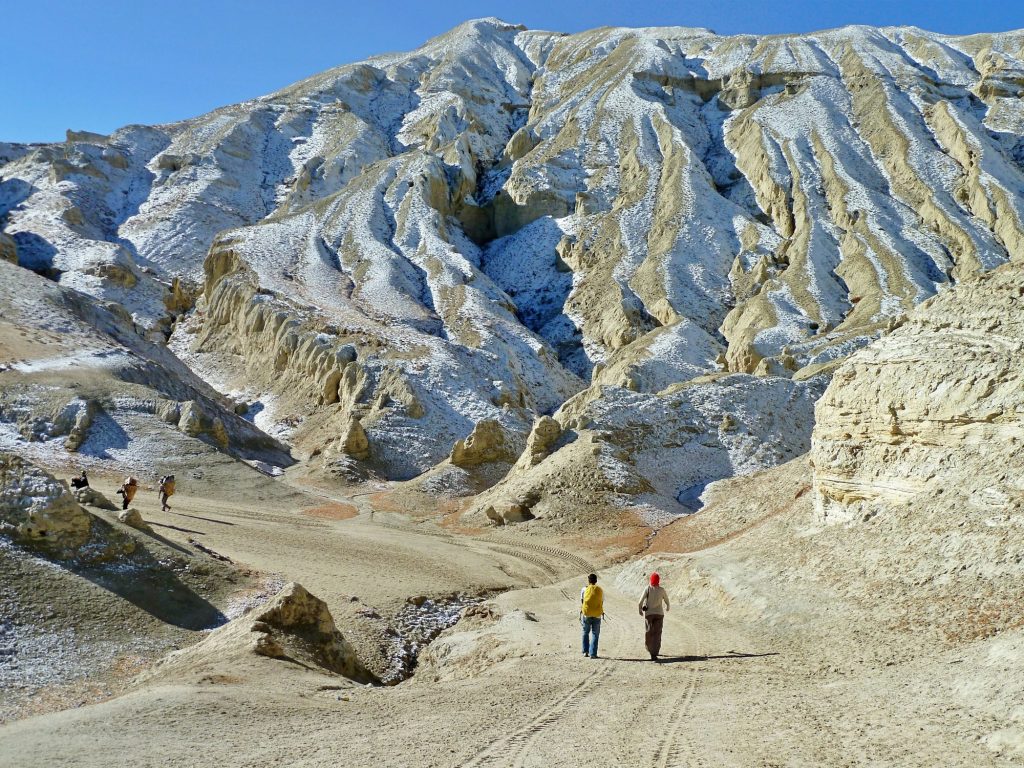
Upper Mustang’s thin air, strong sun and cold wind add to the strain of altitude. Wear sunglasses and sunscreen, cover up against the wind and take frequent short breaks on long climbs.
Frequently asked questions
How high is Upper Mustang?
The inhabited valleys sit mostly between about 2,800 m and 3,900 m. Lo Manthang is about 3,800 m, passes reach about 4,000 m and Kora La on the border is about 4,660 m.
What is the highest point on an Upper Mustang motorbike trip?
Usually the passes between Ghami and Lo Manthang at roughly 3,950–4,080 m, or Kora La at about 4,660 m if included.
Will I get altitude sickness in Upper Mustang?
Many people have a mild headache above 3,000 m. Gradual ascent, rest days and good hydration greatly reduce the risk of anything worse.
Can you get altitude sickness on a motorbike?
Yes. Your body responds to the altitude whether or not you are exercising, and vehicles let you climb faster than you can acclimatise.
How fast can I go up?
Above 3,000 m, increase your sleeping altitude by no more than about 500 m a day and add a rest day for every 1,000 m gained.
Is Muktinath high enough to cause altitude sickness?
Yes. At about 3,700–3,800 m, Muktinath is where most altitude problems in Mustang occur, usually after a rapid ascent.
Should I take Diamox for Upper Mustang?
It is recommended for moderate or high risk. Ask your doctor before travelling.
What are the danger signs?
Confusion, loss of coordination or extreme drowsiness (HACE), and breathlessness at rest or a wet cough (HAPE). Descend immediately.
Is there a hospital in Mustang?
Yes, the provincial hospital in Jomsom. Serious cases are flown to Pokhara or Kathmandu.
Is Upper Mustang higher than Everest Base Camp?
No. Lo Manthang is about 1,500 m lower than Everest Base Camp (5,364 m).
Ride Upper Mustang with time to acclimatise
Our itinerary builds in the nights and rest day your body needs — with a guide trained in altitude first aid.